Showing posts with label unhealthy. Show all posts

Tuesday, May 31, 2011

The Truth About Sports Drinks and Your Family's Health

I'm not trying to make Gatorade the enemy here, however I wanted to explain something I've been saying for the past two years, that was just written about and covered by MSNBC, among other news stations. If you check out the article here, you will notice that the reporter, in the limited time he or she had to writeup the story, didn't really explain why sports drinks are bad for most of us. Energy drinks-it's kind of obvious-there is caffeine in them and your kids shouldn't have them. Sport drinks...do you know why they're contributing to our childhood obesity epidemic? No. Didn't think so and that's ok, I'll break it down for you and then you can choose what's best for you and your child.


First, a little background and science. Sports drinks were designed to QUICKLY replenish valuable energy depleted by vigorous exercise (Gatorade was formulated for the Florida Gators football team to enhance practices and speed up recovery time between them). This is important because when you run a marathon, workout in extreme temps or participate in other energy-draining activities you use up your glycogen store (your stored energy in the body). You need to fuel up again quickly to repair muscles and fuel your body for recovery and normal function. More science ahead, but you get where the need comes from?


So the science. How sports drinks are supposed to work is that when you exercise vigorously (I keep stressing vigorously because taking a walk around the block doesn't cut it) your body uses the glucose already available in your body. It is a naturally occurring sugar that is formed from carbohydrates (which is why I always stress getting the right carbs is key to a healthy diet) in your food. Then it is further broken down to give you energy. (Almost done with the science stuff.) If you are eating a healthy diet you will have a healthy store of glucose in your body so you will need to replenish quickly. If you overeat and/or eat a poor diet, you will have excess glucose in your body that will be stored in your liver, muscles, etc. as fat. Obviously not good.


So here's the problem.


More and more people and their kids are gulping down these sports drinks instead of water for hydration. Yet, exercise has fallen by the wayside and TV and video games are the mainstay. So if you are putting all these sugar and carbs in your body and not utilizing them for exercise they will turn to fat. SIMPLE.


Let's analyze the Nutrition Facts from one 32fl oz. bottle of Gatorade Glacier Ice. At first glance you might think the stats are not that bad. Only 50 calories, 100mg of sodium, 14g of sugars. BUT, THERE ARE 4 SERVINGS PER BOTTLE!! That means there are actually 200 calories, 440 mg of sodium (1/3 of your daily intake in just one drink) and 54g of sugars. WOW.


Again, sugar, salt and carbs are needed for endurance athletes. But you can see why this drink will pose a problem for a kid who's popping chicken nuggets and playing grand theft auto all day.


Let's go into another issue-the ingredients.


Initially when Gatorade was made for the football players, it was pretty much straight glucose and water-pure natural sugars that were readily absorbed by the body to refuel. It tasted gross but did the trick. Then Pepsi bought the drink and changed it for the masses. Now here's a look at what this "sports drink" is filled with:


Water, Sucrose Syrup, Glucose Fructose Syrup, Citric Acid, Natural Flavors, Salt, Sodium Citrate, Monopotassium Phosphate, Ester Gum, Partially Hydrogenated Soybean Oil and Partially Hydrogenated Cottonseed Oil, Blue 1.


Ok let's ignore the glaring offenses of the ambiguous "natural flavors" and sodium citrate and focus in on the insanely unhealthy ingredients listed above. HYDROGENATED OILS!! I know you know these and that you should avoid them because they are TRANS FATS. Yes, in gatorade, aertery-clogging, carcenogenic trans fats. Oh but if those don't get you how about some blue dye. I hear that's good for the kidneys and liver.


By now I hope you're seeing why it's not just about ragging on a sugary drink. It is in fact all about fueling our inactive kids with drinks filled with sub-standard ingredients that are built to make them fat (purposefully or not-you decide).


The alternative. Good, old WATER! Lots of it. And a healthy diet. You can also use Vita-Coco Coconut Water for a natural hydrating drink that replenishes 3 more electrolytes than Gatorade and has only one ingredient: Coconut water.


Oh and PS-this will save you a whole lot of money...:)


Monday, March 14, 2011

Soups at Home Save on SODIUM and on Your Wallet

This soup looks familiar right? Amy's Organic soups can be found in Whole Foods Market, Wegmans (in the Nature's Market section) and all across the country in health food stores.

So why should you care about Amy's soups?

Because if you want to lose weight and live a healthy lifestyle you need to keep your sodium intake to 1500mg or less a day, as regulated by the USDA. (I would suggest keeping it to even less) And considering


ONE TEASPOON OF SALT=2200mg of sodium


you might want to watch how much sodium is in your food.

And please don't say to me "Well, I'm good-I NEVER add salt to any of my foods." PLEASE. Even if you don't, you're not off the hook. So please, please, please read on to see how you can make simple changes that can have dramatic effects on your health.

Also, I also want to clear up confusion about Sea Salt, Himalayan Salt and other types of salts that are supposedly healthy. Salt is salt folks. If you are getting too much sodium in your diet, using a salt that has nutrients in it won't make a difference. Instead, get your low amounts of daily sodium from nuts, seeds and other plant sources that will offer you way more nutrients with each bite.
Ok so processed foods are jam-packed with sodium. After all, salt is what was first used to cure meats and preserve them for a while back in the day right? What do you think is happening now? Salt, chemicals and other things are being used as preservatives and we are feeling the effects. But the reality is, we are all busy and often need to have certain processed items in our pantry. Let's now check out one that is presumably healthy.

1. First, take a look at the nutrition label on this can of Amy's Fat Free Chunky Vegetable Soup. Check out the "servings per container," there are 2!!! That means if you eat that whole can (which most of us would) you need to double all of the information on the label. Sneaky...
2. Second, let's check out the sodium. It is 680mg for only ONE SERVING. If you were to only eat half the can of soup, you would be ingesting HALF of your daily allotment of sodium. Better hope you don't eat much else that day. But who wants to starve for half a can of soup? Ew. Now imagine if you eat the whole can of soup, 1360mg of sodium in only one can. That is all you can have ALL DAY. Bummer. Or make a better choice. Do the math and limit your sodium intake to 500mg per meal per day OR just eat lots of fruits, veggies, nuts, seeds, beans and grains and you won't have to worry.

3. Third, check nutrition labels on all processed foods. You'll be surprised what's hiding. Today we focused on sodium, in the future we will go over other things!

Right now you may be asking-what's the big deal about eating salt or taking in too much sodium anyway?!

Well, if you don't think hypertension (high blood pressure), weight gain, obesity, increased risk of heart disease and stroke, among other things, are a big deal, then you don't have to worry. Otherwise, just be conscious of what's going in your belly.

To help get your soup fix and save on both salt and money, try making soups at home, then freezing them! Here's a recipe that I love from Whole Foods Market with only 190mg per serving and lots of flavor!


Ingredients


1 ounce (about 1 cup) dried porcini mushrooms or other dried wild mushrooms

3/4 cup unsalted cashews

6 cups low-sodium vegetable broth, divided

3 rutabagas, peeled and finely chopped (or just use potatoes)

1 onion, finely chopped

1 red bell pepper, seeded and finely chopped

zest and juice of 1 lemon, divided

3 tablespoons chopped fresh chives

Method

Put mushrooms in a bowl, cover with 1/2 cup boiling water and set aside to let soak 10 minutes.

Meanwhile, in a blender, combine cashews and 2 cups of broth and blend until very smooth, about 1 minute. Pour cashew mixture into a large saucepan and add rutabagas (or potatoes), onion and remaining 4 cups broth. Remove mushrooms from the bowl with a slotted spoon, cut them into bite-size pieces and add them to the pot; carefully pour in the liquid the mushrooms soaked in, being sure to leave behind any grit that has settled in the bottom of the bowl.

Bring the soup to a boil over high heat, lower heat and simmer uncovered for about 20 minutes. Add bell pepper and lemon juice and simmer 3 minutes longer. Serve garnished with chives and lemon zest. Enjoy!

Thursday, March 3, 2011

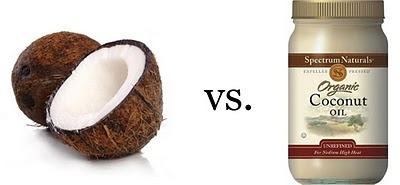
Much Ado About Coconut Oil

As many folks struggle with their weight, diet and health, it's easy to feel overwhelmed by the vast amounts of food/health information out there. One day an egg is good for you, the next it's bad. And so on and so forth...right? This week the spotlight is on coconut oil-as evidenced by a recent New York Times piece on the product. (Read it by clicking here.) Is it good or bad for us?

Well, after my nutrition work at Whole Foods Market, and with my own personal experience as a fast food junkie turned healthy runner, I can tell you the answer is simple...and complex.

It's simple in that it really boils down to this:


That's the simple way to think about it. Whole versus parts. Do you want to eat a real coconut with all the fiber, phytochemicals, nutrients and minerals it has to offer, OR do you want to eat the oil that has come from a factory where they took the coconut and extracted stuff from it to make the oil? The extracted oil is then left with only a fraction of the nutrition (and I'm being generous here) offered by the real, whole coconut. I mean it comes in a jar folks!

Ok that was the simple. Now to the complex. I'm not saying we should give up on coconut oil altoghether-I find American eaters for the most part tend to think in extremes, all or nothing. That part, is not that simple. Nutritionally-coconut oil does have saturated fat in it, which we know is bad. There are somewhat "healthier" saturated fats that are called mono-or-polyunsaturated fats, but at the end of the day coconut oil still has saturated fat in it (as does an actual coconut but I'll get to that in a minute). And it also has 120 calories ALL from fat per TABLESPOON. So this is where the complex answer comes in.

Is it bad for us? Well sorta. If you are focusing on getting the most bang for each bite you take in, coconut oil will pretty much give you empty calories without fiber (to fill you up) and with potentially fattening effects. AND if you are already getting too many calories each day as it is, without lots of fruits and veggies-this will do you no good. So avoid it AS YOU WOULD ANYTHING WITH EMPTY CALORIES AND SATURATED FAT.

Please don't go bash coconut oil as you eat your cheeseburger-that's just ridiculous. Apply these rules across the board. Catching the drift?

Now-that said. If you read my "Moderation" blog post from earlier this week you know what I'll say next. People who have healthy diets across the board-meaning they eat lots of plants and omit lots of processed foods-would probably use this in a veggie stir fry or to make vegan cupcakes. That is ok and in fact healthy. They are getting a great diet as it is, they are not overdosing on chips and fat and can stand a little fat and/or variation here.

Almost done...so back to simple. If you don't want to worry about all the stuff I just wrote, it is as simple as eating whole, real foods-stuff that is not in a jar, and/or that does not have a label. A coconut. Yes, an actual coconut has saturated fat (as we talked about above), but it also has fiber, nutrients, minerals and other things that will really contribute to a healthy diet. So again, get rid of the extreme here-I'm not saying eat coconuts all day everyday, but if you want one, eat one. A real one.

Plants are easy folks. They are built to nourish us in ways we don't even know possible yet. Eat them whole and often. Keep that simple mentality in your head everytime you see the latest spin on a food and you will be golden. Hope it helps!


Thursday, February 24, 2011

Moderation is for the Birds...


Moderation...

We hear this all the time. Someone will say to me "I just ate a cheeseburger, do you want one?" and I say something like "No thank you, I don't eat cheeseburgers but I hope you enjoy it!" I could just say "No thank you," but it is usually followed by a parade of questions so I just try to keep things simple and honest. Can you tell by my posts yet?
This type of conversation usually ends up with the person wrapping things up by saying everything in moderation...blah, blah, blah.
I have a HUGE problem with this ambiguous word. What does it mean to you? Probably something different than what it means to me. And it would be no big deal except that we seem to be killing ourselves with moderation.
Let's use an example here shall we? We shall. Say you drink 3 diet cokes a day and eat a breakfast of eggs and bacon, a turkey sandwich with chips for lunch and a dinner of steak and a baked potato with maybe a veggie. Seems like a pretty standard diet for a lot of folks, folks I know...folks who are even in my family. So moderation to them may mean cutting back to only 1 diet coke a day and having cake once every month. Ok-so where does that leave them? STILL with high cholesterol, blood pressure and an increasing waisteline. YES? Yes.
Because the bottom line is that if you have a fundamental problem with your eating habits and you only make surface level changes-you will only see surface level changes if anything at all. Eating a diet rich in sodium, cholesterol, fat and sugar is still a diet rich in all those things whether you only eat cake in moderation or not.
So I say SCREW MODERATION. Yes. screw it. Instead, if you are looking for serious change in your diet, and consequently your health-you need to make fundamental changes in what you eat...then moderate.
For example, if you eat a diet rich in fruits, veggies, beans, nuts, seeds and grains you have a healthy base of meals to work from and are protecting yourself against many of the chronic diseases plaguing America today (obesity, Type II diabetes, Heart Disease, etc.) on a daily basis. Therefore eating a cheeseburger, piece of cake or, in my case a chicken finger sub, once a week or so probably won't kill you. Eating that stuff daily probably will. This is healthy moderation if you want to call it that. Making sure that 23 of your last 25 meals are healthy so you can enjoy the taste of a cheeseburger on your cheat day.
Don't settle for moderation or try to justify your bad eating habits with one word. Instead, understand your self worth and try to rise above moderation's mediocrity. Pretty please?

Tuesday, February 22, 2011

Don't Feel Bad Asking...

Often times I encounter people who don't know what kind of meat is in their sandwich or where it comes from.

I offer this piece of advice. If you eat meat, I would strongly encourage you to ask what the meat looks like or where it comes from before eating it. Over the weekend, I went into DiBella's Subs in Rochester to get a veggie sub. I saw they had a new sub on the menu called the "Buffalo Chicken." It is my go-to thing on cheat days so I wanted to check it out for future reference. When I asked the guy to show me the chicken he used, he pulled out something like this...

...and told me he just dumped it in buffalo chicken sauce and put it on the sub. Um ew. What's in this stuff? I wish I could tell you without going to the store, but Tyson won't post the ingredients on their website! It is, however, listed under "Chicken Products" so I'll assume there is at least some chicken in there. Think about it though-how do they get it to stay on the shelf for so long AND what does that do to your body?!!

So by taking two seconds to ask the sub guy if I "could see" the chicken he would use on the sub-I saved myself the disappointment of eating something that wouldn't taste good and also kept potentially harmful additives and preservatives from unknowingly going into my body.

It's our job to know guys-our job to know what we put in our mouth and our family's mouths. (yes i realize that you can giggle about the above statement but also please take it to heart!)

So if you are like me and one day desire a chicken finger sub, please make sure your chicken fingers come from actual chickens and are made in-house with real ingredients. They'll taste better and be healthier for you! This goes for all food! :)
Stay tuned for tonight's post! I'll give you a killer recipe on how to make vegan lentil burgers! Yum!


Saturday, February 19, 2011

Let's Play "Guess the Hidden Ingredient"

Can you see it? Do you look at labels and ingredient lists? I hope so! If not, it's never too late to start. As evidenced here in something as simple as a package of turkey polish sausage-ingredients are often very complicated when they don't need to be!

In this case, Hillshire Farms has added "Monosodium Glutamate" or MSG to its polish sausage to enhance flavor. That's all fine and good if you want an added salty, potentially carcinogenic, mess in your food. It's up to you whether you do or not, just please make it a choice, not a surprise. :)